
Field Sobriety Tests Rights During a DUI Traffic Stop
Know your field sobriety tests rights during a DUI traffic stop, including when you can refuse and how to protect yourself without escalating the encounter.

By Mateo Sinclair
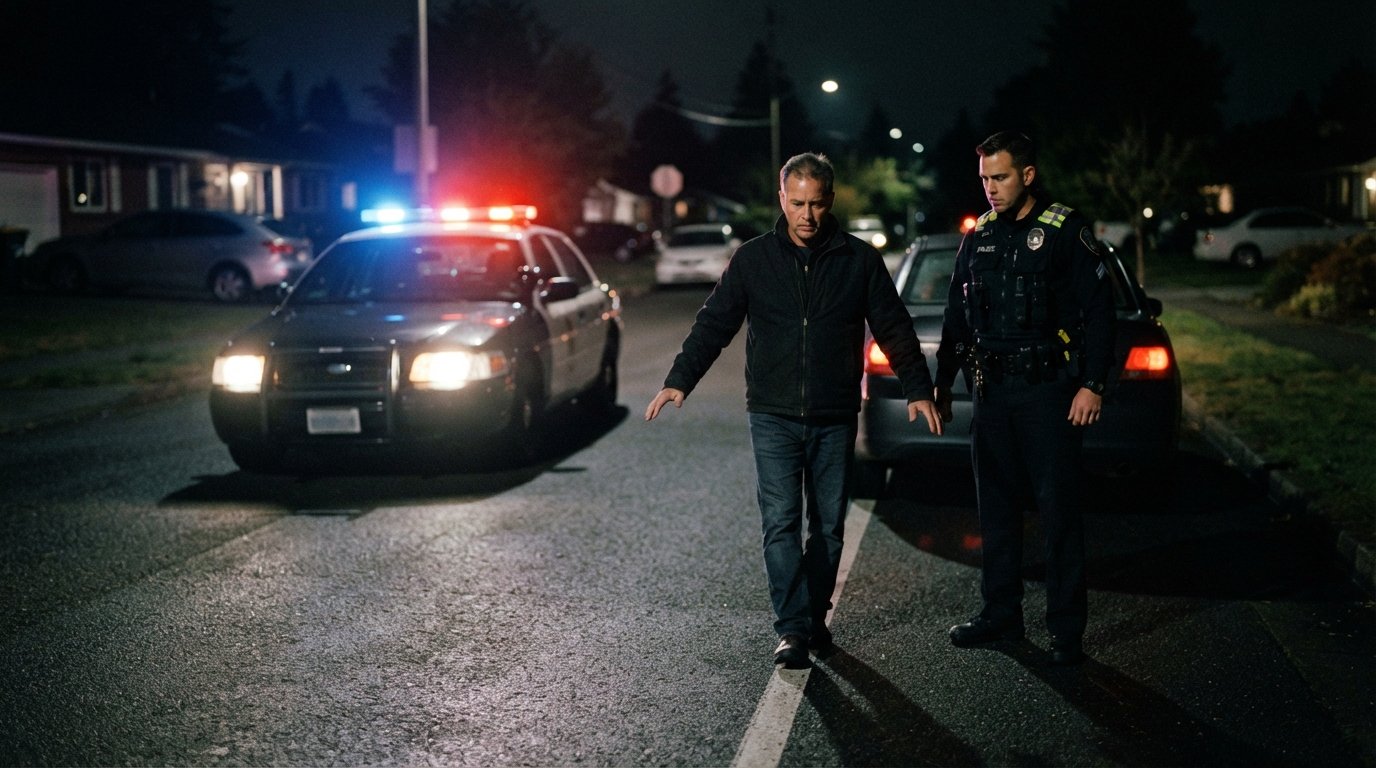
You see the flashing lights in your rearview mirror, and your heart sinks. The officer approaches your window, and after a few questions, asks you to step out of the vehicle. The request that follows, to perform a series of roadside exercises, is one of the most misunderstood moments in criminal law. Understanding your field sobriety tests rights during a DUI traffic stop is not about helping anyone evade responsibility. It is about knowing the boundaries of police authority and protecting your constitutional freedoms under pressure.
This guide explains what those tests are, what officers can and cannot require, and how your choices at the roadside can shape everything that happens afterward. The information here is educational only. LawyerCaseReview.com is not a law firm and does not provide legal advice. If you are facing charges, a confidential case evaluation with a licensed attorney is the fastest way to understand your actual options.
What Are Field Sobriety Tests, Exactly?
Field sobriety tests (FSTs) are a group of physical and cognitive exercises that police officers use to estimate whether a driver is impaired. They are not breath tests and they are not chemical tests. They are observations, scored subjectively by the officer standing in front of you. The National Highway Traffic Safety Administration (NHTSA) standardized three of them, and those three carry the most weight in court.
The standardized battery includes the horizontal gaze nystagmus test, the walk and turn, and the one leg stand. In each one, the officer looks for specific clues, such as jerking eye movements, missed heel-to-toe steps, or swaying. Officers add the clues up and decide whether the performance suggests impairment. A non-standardized test, like reciting the alphabet backward or counting on your fingers, may also appear, but these carry far less scientific weight.
What matters legally is that these are voluntary in most circumstances. They are not the same as a chemical test of your breath or blood, which is governed by implied consent laws in every state. That distinction is the foundation of nearly every rights question that follows.
Your Core Rights During a DUI Traffic Stop
The Fourth Amendment protects you against unreasonable searches and seizures. The Fifth Amendment protects you from being forced to incriminate yourself. Together, these two amendments shape almost everything that happens during a DUI investigation. Officers can investigate, but they cannot compel you to build the case against yourself.
In practical terms, you generally have the right to remain silent beyond identifying yourself, the right to decline field sobriety exercises, the right to refuse a preliminary breath test in many states, and the right to consult a lawyer before deciding on a chemical test where state law allows it. You also have the right to record the interaction if your state permits it, and the right to observe whether the officer is following proper procedure.
Those rights do not stop the arrest. An officer can still arrest you based on driving behavior, slurred speech, the odor of alcohol, or admissions you make. But exercising your rights can limit the evidence the prosecution has to work with later. That is why the decision at the roadside matters so much.
Can You Refuse a Field Sobriety Test?
Yes, in the vast majority of states you can politely decline to perform field sobriety tests. These exercises are not covered by implied consent laws, which apply only to chemical testing of breath, blood, or urine. Refusing them usually triggers no automatic license suspension on its own, though the officer may treat the refusal as a factor supporting arrest.
That said, refusal is a strategic decision, not a magic shield. Prosecutors frequently argue that a sober, cooperative driver would simply complete the tests. An officer may write in the report that you refused, and that refusal can be mentioned at trial. Some states also allow refusal to be used as evidence of consciousness of guilt, depending on local rules.
If you do refuse, do it respectfully. Say something simple like, "I do not wish to perform field sobriety tests, but I will comply with lawful instructions." Do not run, do not argue, and do not physically resist. The goal is to preserve your rights without giving the officer a separate charge to add.
If you do decide to take the tests, understand that you are handing the state a recorded performance it can replay in court. There is rarely a way to "pass" perfectly under stress, in bad lighting, on uneven pavement, wearing uncomfortable shoes. Even sober people produce clues. This is one reason many defense attorneys prefer that clients decline the roadside exercises and reserve their challenge for the chemical test and the traffic stop itself.
What Officers Can and Cannot Require
Officers can require you to exit the vehicle. That is settled law after Pennsylvania v. Mimms. They can require you to provide your name, license, registration, and proof of insurance. They can ask questions, and they can order you to stay at the scene while they investigate. They can also arrest you if they develop probable cause.
What they cannot do is physically force you to perform the walk and turn or the one leg stand. They cannot threaten you with jail simply for declining those exercises, though the threat sometimes happens anyway. They cannot search your vehicle without consent, a warrant, or a recognized exception such as probable cause plus exigent circumstances. And they cannot extend a routine traffic stop indefinitely without reasonable suspicion of a crime.
If an officer crosses one of those lines, a defense attorney can file a motion to suppress. Evidence that flows from an unlawful stop or an unlawful search can be thrown out, and in some cases the entire case collapses. That is why the details of the stop, not just the test results, matter so much.
Standardized Tests and Their Known Flaws
The three NHTSA tests are treated as science in many courtrooms, but their accuracy is far from perfect. Even under ideal conditions, the walk and turn and one leg stand produce false positives at meaningful rates. The horizontal gaze nystagmus test is especially vulnerable to challenge because it depends on the officer's visual judgment and on factors such as head injuries, certain medications, and even eye fatigue.
Real world conditions make things worse. Roadside tests are often given on slopes, in gravel, in the dark, with headlights blinding the driver, and in cold or wet weather. Drivers with back problems, inner ear conditions, foot injuries, or obesity may struggle regardless of sobriety. Officers rarely account for these variables in their scoring.
Defense attorneys routinely attack the administration of the tests: Did the officer give complete instructions? Did the officer demonstrate correctly? Was the scoring sheet filled out accurately? Did the officer deviate from the NHTSA manual? Any of these issues can weaken the prosecution's case and create room for negotiation or dismissal.
Chemical Tests Are a Different Rulebook
Once you are arrested, you enter the world of implied consent. Every state has a law that says driving on public roads means you have already agreed to submit to a chemical test of your breath, blood, or urine when lawfully arrested for DUI. Refusing that test typically triggers an automatic license suspension, even before any criminal case is resolved.
This is where the stakes change. Refusing field sobriety tests is generally safe from an administrative standpoint. Refusing a chemical test is not. Many states also allow a warrantless blood draw in certain situations, and the Supreme Court has weighed in on when that is permissible. If you are unsure what your state allows, ask for a lawyer before deciding. In many jurisdictions, officers must give you a reasonable opportunity to consult counsel before the chemical test.
The results of a chemical test are the most powerful evidence in a DUI case. A properly administered breath or blood test with a result above the legal limit creates a strong presumption of guilt. That is why the fight often shifts to whether the test was administered correctly, whether the machine was calibrated, whether the blood sample was handled properly, and whether the officer had legal grounds to request the test in the first place.
How the Traffic Stop Itself Can Be Challenged
Every DUI case begins with a traffic stop, and every traffic stop requires legal justification. An officer needs reasonable suspicion that a traffic violation or crime occurred. Weaving, speeding, a broken taillight, or an illegal turn can all provide that justification. But if the stop was based on a hunch, an anonymous tip without corroboration, or a mistake of law, the entire case may be suppressible.
Defense attorneys examine the stop in detail: When did the officer first observe the vehicle? What was the stated reason for the stop? Was the reason documented in the report, or did it change over time? Was the stop prolonged beyond its original purpose? Did the officer ask questions unrelated to the traffic violation? Any inconsistency can become a powerful tool for the defense.
This is also where broader legal experience matters. Attorneys who handle DUI cases often also handle related matters like probation violations, and the strategies overlap. If you want to see how legal teams handle disputes that involve complex procedural rules, you can read this guide on what happens when a mortgage lender contests bankruptcy, which illustrates how procedural missteps by the other side can change the entire outcome of a case.
Practical Steps to Protect Yourself at the Roadside
The moments after the lights come on are chaotic. A simple framework can help you stay calm and avoid mistakes that follow you for months. The goal is not to win an argument with the officer. The goal is to preserve your rights and avoid giving the prosecution free evidence.
- Pull over safely and stay in the vehicle. Keep your hands visible, turn on the interior light at night, and avoid sudden movements. Reaching for a glovebox without telling the officer can be misinterpreted.
- Be polite but brief. Provide your license, registration, and insurance. You can answer basic identification questions, but you are not required to answer questions about how much you drank or where you were coming from.
- Decline field sobriety tests if you choose to. Say it clearly and respectfully. Do not argue, do not explain at length, and do not perform partial tests to seem cooperative.
- Ask for a lawyer before the chemical test. In many states you have a right to counsel before deciding. Use that time. Do not refuse the chemical test without understanding the license consequences in your state.
- Document everything you remember. Write down the time, location, officer name and badge number, what was said, and any conditions like rain, slope, or poor lighting. Memory fades, and details matter.
After the stop, do not post about the incident on social media. Prosecutors do look. Do not discuss the case with anyone except your attorney. And do not assume that a single mistake at the roadside means the case is lost. Many DUI cases are resolved through negotiation, diversion programs, or suppression motions that remove the strongest evidence from the prosecution's hands.
When to Bring in a Defense Attorney
If you were arrested, the answer is immediately. DUI law is procedural and technical, and the deadlines are short. License suspension hearings often must be requested within days, not weeks. An attorney can request the officer's reports, the dashcam and bodycam footage, the calibration records for the breath machine, and the maintenance logs for the testing equipment. That evidence is often the difference between a conviction and a dismissal.
If you are not sure where to start, a free case review is a low-pressure way to learn what a lawyer thinks about your situation. Platforms like FormsByLawyers connect people with legal professionals who handle DUI and related matters, and they can help you understand the process before you commit to representation. LawyerCaseReview.com offers a similar service, matching individuals with attorneys for confidential evaluations at no upfront cost.
The right attorney will not promise a specific outcome. They will explain the charges, the possible penalties, the strength of the evidence, and the realistic paths forward. That honesty is far more valuable than a guarantee.
Frequently Overlooked Rights and Details
Several rights get lost in the stress of the moment. You have the right to know why you are being detained, though the officer may not answer fully. You have the right to a translator if you do not speak English well. You have the right to medical attention if you are injured or ill. You have the right to have someone notified of your arrest. And you have the right to remain silent at every stage, not just at the initial stop.
You also have the right to review the evidence against you. Your attorney can demand the dashcam video, the bodycam video, the dispatch records, and the officer's notes. If the video contradicts the report, that contradiction can be devastating to the prosecution. If the video is missing or was not preserved, that may raise its own legal issues.
Finally, remember that field sobriety tests rights during a DUI traffic stop are not a loophole. They are constitutional protections that apply to everyone, including people who made a mistake and people who were completely sober. Knowing them helps you make better decisions in a moment when decisions matter more than almost any other.
If you are facing a DUI charge and want to understand your options, the most useful step you can take is to speak with a licensed attorney in your state. The information here is for educational purposes only and is not legal advice. A confidential case evaluation can give you a clear picture of where you stand and what comes next.