
Truck Accident Settlement Process and Maximizing Compensation
Navigate the truck accident settlement process and maximizing compensation with clear steps. Call 8338648408 for a free case review today.

By August Redford
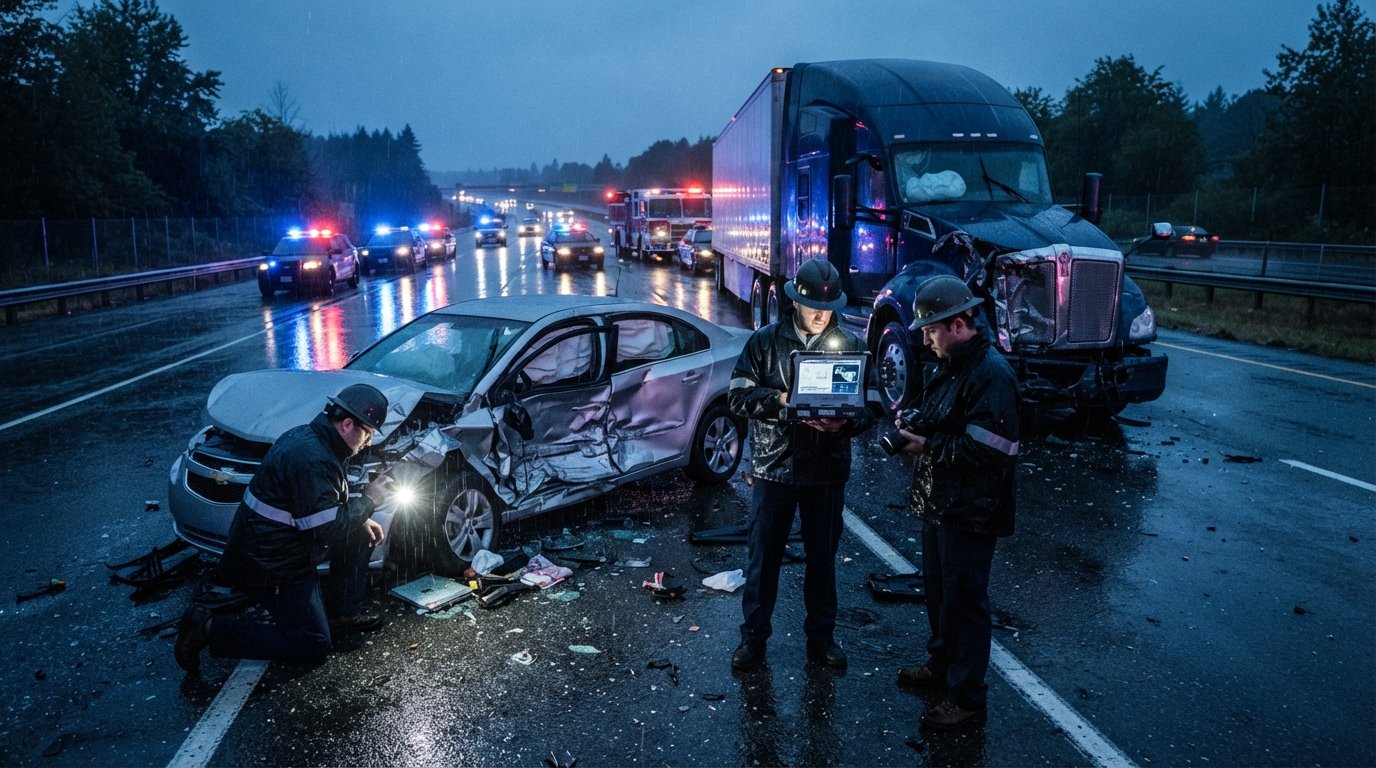
A fully loaded semi truck can weigh 80,000 pounds. When that mass collides with a passenger vehicle, the results are catastrophic, and the legal fight that follows is nothing like a typical fender bender. Truck accident claims involve federal safety regulations, multiple corporate defendants, black box data, and insurance carriers who deploy teams of investigators within hours of a crash. Understanding the truck accident settlement process and maximizing compensation requires knowing how these cases differ from ordinary car wreck claims, where the leverage points are, and what mistakes can quietly shrink a fair recovery.
This guide walks through how trucking settlements actually unfold, from evidence preservation through final payout, and explains the practical steps that give injured victims and their families the strongest position at the negotiating table.
Why Truck Accident Claims Are Different From Car Accident Claims
A standard car accident claim usually involves two drivers and two insurance policies. A truck accident claim often involves a driver, a motor carrier, a freight broker, a maintenance contractor, a cargo loader, and sometimes a manufacturer of defective parts. Each of those parties may carry its own insurer, its own legal team, and its own strategy for deflecting blame. That complexity is not a side detail; it is the central reason truck accident settlements can reach six or seven figures while car accident settlements, on average, stay far lower.
Federal rules add another layer. The Federal Motor Carrier Safety Administration regulates hours of service, driver qualification files, drug testing, and vehicle maintenance. When a carrier violates those rules and a crash follows, the violation itself can become powerful evidence of negligence. Skilled attorneys request the carrier's safety records early, because those documents frequently reveal a pattern of ignored violations that transforms a disputed claim into a case the carrier wants to settle quietly.
For context on how vehicle size and injury severity drive case value, our breakdown of average car accident settlement amounts in 2026 shows how medical costs, lost wages, and pain and suffering are calculated in vehicle collision cases. Truck claims follow similar principles but with larger numbers because the injuries and the available insurance limits are usually much greater.
The Truck Accident Settlement Process, Step by Step
Settlement is not a single event. It is a sequence of stages, and how well each stage is handled determines what the final offer looks like. The process typically unfolds as follows.
- Immediate evidence preservation. The trucking company's legal team may begin investigating within hours. A victim's attorney must move just as fast, sending spoliation letters to preserve electronic logging device data, dashcam footage, driver logs, maintenance records, and the truck itself.
- Formal investigation and liability analysis. Attorneys reconstruct the crash, review federal compliance records, and identify every potentially liable party, including brokers and shippers who may share responsibility under vicarious liability theories.
- Medical treatment and documentation. Consistent, well-documented treatment creates the medical record that supports damages. Gaps in treatment are routinely used by insurers to argue that injuries were minor or unrelated to the crash.
- Demand package and negotiation. Once liability and damages are documented, the attorney submits a comprehensive demand to the insurers. Negotiation may continue for months before a realistic offer emerges.
- Lawsuit filing and litigation. If negotiations stall, the case moves to court. Filing suit often changes the carrier's calculus, because discovery exposes internal documents the company would rather not see presented to a jury.
- Mediation or trial, then payout. Most truck cases resolve through mediation or a negotiated settlement before trial. After the agreement is signed, liens are resolved and the net recovery is distributed.
Each stage builds on the last. A weak investigation undermines the demand package; a thin medical record undermines the negotiation. The cases that produce top-dollar settlements are the ones where every stage was handled thoroughly and in the correct order.
How Compensation Is Calculated in Truck Accident Cases
Compensation in a truck accident claim generally falls into two broad categories: economic damages and non-economic damages. Economic damages are the measurable financial losses, including emergency room bills, surgeries, rehabilitation, prescription costs, future medical care, lost income, and reduced earning capacity. These figures are documented with bills, wage statements, and expert testimony from physicians and economists.
Non-economic damages cover the human cost: pain, suffering, emotional distress, loss of enjoyment of life, and, in the most serious cases, loss of consortium for a spouse. These damages are harder to quantify, which is exactly why insurers fight them hardest. A strong claim supports non-economic damages with testimony about how the injury changed daily life, not just with a diagnosis code.
When a crash causes a death, surviving family members may pursue a wrongful death claim that adds funeral expenses and loss of financial support and guidance. Punitive damages may also enter the picture in rare cases involving gross negligence, such as a carrier that knowingly kept an impaired or unqualified driver on the road.
What Determines the Value of a Truck Accident Settlement
Two cases with identical injuries can settle for vastly different amounts. The difference usually comes down to a handful of factors that insurers and attorneys weigh constantly.
- Severity and permanence of injury: Spinal cord damage, traumatic brain injury, amputations, and severe burns command far higher values than soft tissue injuries that resolve in weeks.
- Clarity of liability: When federal violations, admissions, or dashcam footage make fault obvious, carriers tend to settle faster and higher to avoid a public trial.
- Available insurance coverage: A carrier with a $1 million policy and a strong case can pay more than a small operator with a $750,000 policy, regardless of the injury. Commercial auto policies, umbrella coverage, and broker liability all expand the pool.
- Quality of documentation: Complete medical records, expert reports, and a clean treatment history raise value. Gaps and inconsistencies lower it.
- Jurisdiction and venue: Some courts and communities are far more favorable to injury victims than others, and that reality shapes every settlement offer.
Because these factors interact, an experienced truck accident attorney evaluates a case holistically rather than relying on a formula. A case with moderate injuries but rock-solid liability evidence and substantial coverage may be worth more than a catastrophic injury case where fault is disputed and insurance limits are thin.
Maximizing Compensation: Mistakes That Cost Victims Money
The single most common way victims lose value is by talking to the trucking company's insurer before consulting an attorney. Adjusters are trained to extract statements that later undercut claims, and a recorded statement given in the days after a crash can follow a victim through the entire case. There is no obligation to give a recorded statement to the opposing carrier, and polite refusal is almost always the right move.
A second costly mistake is delaying medical treatment. Even a minor delay can be framed as evidence that the injury was not serious, and insurers regularly argue that later symptoms stem from something other than the crash. Consistent, prompt treatment protects both health and legal position.
A third mistake is accepting a quick settlement. Early offers may sound generous when medical bills are still arriving and the full extent of an injury is unknown. Once a release is signed, the case is closed forever, even if complications emerge later. Victims who need guidance on how to connect with qualified representation can use services like FreeLegalCaseReview, which provides free, confidential case evaluations and connects injured people with experienced personal injury and mass tort attorneys. LawyerCaseReview.com is not a law firm and does not provide legal advice, but its case review process helps victims understand their options without pressure.
Other practical steps that protect and grow a claim include documenting the scene, preserving the damaged vehicle, tracking all out-of-pocket expenses, and keeping a daily journal describing pain, limitations, and emotional toll. Small details, gathered consistently, often become the evidence that justifies a higher non-economic damages figure.
How Long Does a Truck Accident Settlement Take
Timelines vary widely, but most truck accident cases settle somewhere between several months and two years after the crash. Straightforward cases with clear liability and cooperative insurers may resolve in six to nine months. Complex cases involving disputed fault, multiple defendants, catastrophic injuries, or pending litigation frequently take a year or longer.
Rushing a settlement to get money quickly almost always reduces the total recovery, because the full scope of future medical needs and lost earning capacity may not yet be known. On the other hand, unnecessary delay carries its own risks, including evidence loss and statute of limitations deadlines. Most states impose a two to three year filing window for personal injury claims, with shorter deadlines for claims against government entities, so waiting too long can destroy an otherwise valid case.
When to Bring in a Truck Accident Attorney
Truck accident cases are among the most resource-intensive personal injury matters, and insurers know which victims are represented and which are not. An attorney levels the playing field by handling evidence preservation, expert retention, negotiation, and, if necessary, trial. The sooner an attorney is involved, the more evidence remains available and the stronger the eventual claim.
For victims and families weighing their next step, a free case evaluation is a low-risk way to learn what a claim may be worth and how the truck accident settlement process and maximizing compensation work in practice. With the right evidence, the right experts, and the right representation, a fair recovery is far more achievable than most people expect.