
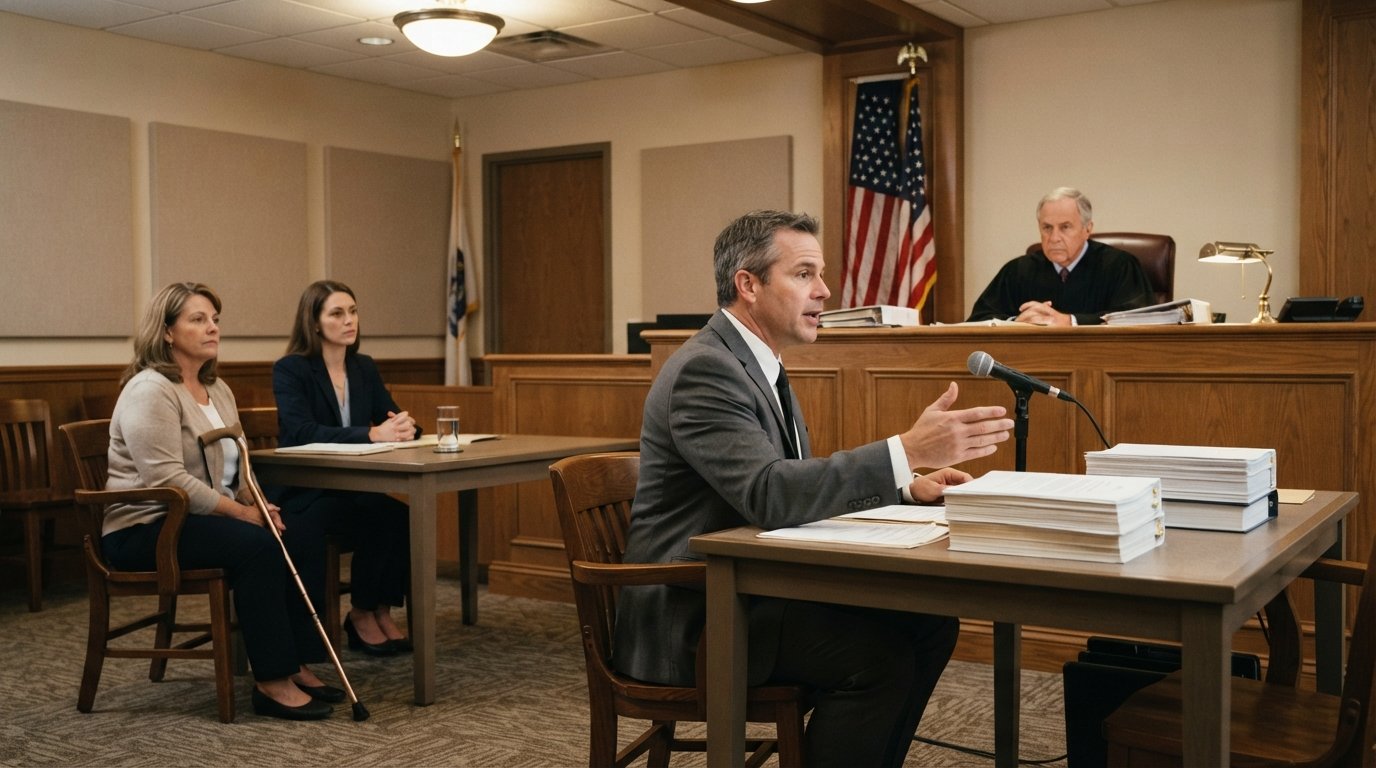
Vocational Expert Testimony in Social Security Disability Hearings
Vocational expert testimony in social security disability hearings can make or break your claim. Call (833)-864-8408 for a free case review.

By Rhea Montoya
You have submitted your application for Social Security Disability Insurance (SSDI) or Supplemental Security Income (SSI). You have provided medical records, work history, and personal statements. Then you receive a notice that your case is headed to an administrative hearing. At that hearing, a vocational expert will testify about your ability to work. This testimony often determines whether you receive benefits or face another denial. Understanding what the vocational expert does, how the judge uses that testimony, and how your attorney can challenge it is essential to protecting your claim.
Vocational expert testimony in social security disability hearings carries enormous weight. Administrative Law Judges (ALJs) rely on vocational experts to translate medical limitations into real-world employment answers. If the expert says jobs exist that fit your residual functional capacity (RFC), the judge may deny benefits. If the expert says no such jobs exist, the judge may approve them. The difference between approval and denial frequently rests on a few carefully worded questions and answers.
This article explains the role of the vocational expert, the framework used to evaluate work capacity, the specific questions judges ask, and the strategies attorneys use to cross-examine vocational experts. It also covers common mistakes claimants make and when to involve legal counsel through a service like When to Hire a Social Security Disability Benefits Lawyer.
What Is a Vocational Expert in a Disability Hearing?
A vocational expert (VE) is a professional with specialized knowledge in occupational analysis, job classification, and labor market conditions. The Social Security Administration (SSA) maintains a roster of qualified vocational experts who testify at disability hearings across the country. They typically hold degrees in vocational rehabilitation, counseling, or a related field, and they have experience placing people with disabilities into jobs or evaluating work capacity.
Unlike a medical expert, who addresses physical or mental impairments, the vocational expert focuses on the world of work. They answer questions about the physical and mental demands of jobs, the availability of those jobs in the national economy, and whether a hypothetical person with specific limitations could perform any of them. Their testimony is not about your specific situation alone; it is about how a person with your assessed limitations would function in the labor market.
The ALJ usually calls the vocational expert to testify after medical experts and the claimant have presented evidence. The VE may have reviewed your file in advance, including your work history and RFC assessments, or may be hearing the details for the first time at the hearing. In either case, the VE's answers to the judge's hypothetical questions form the basis for the ultimate disability determination.
Because vocational expert testimony in social security disability hearings is so influential, both the claimant's attorney and the judge treat the VE's role with care. The VE must be impartial, but their testimony can be challenged if it is inconsistent with the Dictionary of Occupational Titles (DOT), the Selected Characteristics of Occupations (SCO), or reliable labor market data.
The Sequential Evaluation and the Vocational Expert's Role
The SSA uses a five-step sequential evaluation process to decide disability claims. The vocational expert becomes relevant at step four and step five. At step four, the ALJ determines whether you can perform your past relevant work. At step five, the ALJ determines whether you can perform any other work that exists in significant numbers in the national economy. Vocational expert testimony is most critical at step five.
To reach step five, the ALJ first establishes your residual functional capacity (RFC). The RFC is a summary of what you can still do despite your impairments. It includes physical limitations (how much you can lift, stand, walk, sit, and manipulate objects) and mental limitations (how well you can understand, remember, concentrate, and interact with others). The RFC is the foundation for the vocational expert's analysis.
The ALJ then presents hypothetical questions to the vocational expert. Each hypothetical describes a person with a specific set of limitations. The VE must state whether that hypothetical person can perform the claimant's past work or any other jobs. If the VE identifies jobs that fit the hypothetical, the ALJ may deny benefits. If the VE says no jobs exist, the ALJ may approve benefits.
This framework means that the accuracy of the RFC and the precision of the hypothetical questions are decisive. An RFC that omits a limiting condition, such as the need to lie down during the day or the inability to stay on task, can lead the VE to identify jobs that are not actually suitable. Attorneys therefore focus on ensuring the RFC captures all credible limitations before the VE testifies.
How Vocational Experts Determine Available Jobs
Vocational experts rely on several sources to determine whether jobs exist for a person with given limitations. The primary source is the Dictionary of Occupational Titles, a publication that describes thousands of jobs and their physical and mental requirements. The DOT classifies jobs by strength level (sedentary, light, medium, heavy, very heavy) and by specific vocational preparation (SVP), which reflects the time needed to learn the job.
The vocational expert also uses the Selected Characteristics of Occupations, which supplements the DOT with more detailed information about environmental conditions, postural limitations, and manipulative requirements. In addition, VEs may consult labor market surveys, employer contacts, and their own experience placing workers in jobs. The SSA expects VEs to explain the basis for their testimony, especially when their conclusions conflict with the DOT.
A vocational expert typically follows a structured approach when testifying:
- Review the claimant's past relevant work and classify it by exertional level and skill level.
- Consider the hypothetical limitations provided by the ALJ, including exertional and non-exertional restrictions.
- Determine whether the claimant can perform past relevant work as actually performed or as generally performed in the national economy.
- If past work is not available, identify other jobs that fit the hypothetical limitations and that exist in significant numbers.
- Provide the specific DOT codes, job titles, and estimated numbers of jobs for each occupation identified.
After the VE provides this information, the ALJ may ask follow-up questions. The claimant's attorney then has the opportunity to cross-examine the VE. This cross-examination is often the best chance to expose weaknesses in the VE's testimony or to clarify limitations that the judge's hypothetical questions may have overlooked.
It is worth noting that vocational expert testimony in social security disability hearings is not binding on the ALJ. The ALJ must weigh the VE's testimony along with all other evidence. However, in practice, ALJs give substantial weight to VE testimony, and denying benefits without a VE's support at step five is difficult. This is why challenging VE testimony effectively requires legal skill and preparation.
Common Hypothetical Questions and What They Reveal
The hypothetical question is the central tool the ALJ uses to obtain vocational expert testimony. A well-constructed hypothetical includes all the claimant's credible limitations. A poorly constructed hypothetical may omit key restrictions, leading the VE to identify jobs that the claimant cannot actually perform. Attorneys pay close attention to the wording of each hypothetical and object when limitations are missing.
Typical hypothetical questions address the following areas:
- Exertional limitations: how much the person can lift and carry, how long they can stand or walk, and whether they need a sit-stand option.
- Postural limitations: how often the person can climb, balance, stoop, kneel, crouch, or crawl.
- Manipulative limitations: how well the person can reach, handle, finger, or feel objects.
- Environmental limitations: whether the person must avoid extreme temperatures, humidity, dust, fumes, or hazards.
- Mental limitations: the person's ability to understand, remember, and carry out instructions, respond to supervision, and interact with coworkers and the public.
Each limitation can dramatically affect the number of jobs available. For example, a person who can perform sedentary work but must alternate sitting and standing at will may be limited to a small subset of sedentary jobs. A person who cannot maintain concentration for two-hour intervals may be unable to perform even unskilled work. The VE must consider these factors when answering.
Attorneys often ask the VE to consider additional limitations that the ALJ's hypothetical omitted. If the VE testifies that no jobs exist with those additional limitations, the attorney can argue that the RFC should include them. This strategy can turn a denial into an approval. Conversely, if the VE identifies jobs despite severe limitations, the attorney may challenge the VE's reliance on outdated DOT data or on job numbers that do not reflect the current labor market.
Because vocational expert testimony in social security disability hearings can be complex, many claimants benefit from professional representation. An experienced attorney knows how to frame hypothetical questions, cross-examine the VE, and preserve issues for appeal. If you are unsure whether to hire a lawyer, resources such as AttorneyLawsuit can help you understand your rights and options.
Cross-Examining the Vocational Expert
Cross-examination is the claimant's primary opportunity to test the vocational expert's testimony. A skilled attorney will ask questions designed to reveal inconsistencies, gaps in the VE's knowledge, or errors in job classification. The goal is not to badger the VE but to ensure the record contains accurate information the ALJ can rely on.
Effective cross-examination often focuses on the following areas:
- Whether the VE's testimony conflicts with the DOT and, if so, whether the VE has a reasonable explanation supported by reliable data.
- Whether the job numbers the VE cites are current and based on acceptable sources, such as the Bureau of Labor Statistics or credible labor market surveys.
- Whether the VE considered all the claimant's limitations, including those the ALJ's hypothetical may have omitted.
- Whether the jobs identified require skills or abilities that the claimant does not possess.
- Whether the VE's experience and qualifications support the conclusions offered.
One common issue is the DOT's age. The DOT was last updated in the 1990s, and many job descriptions are outdated. Vocational experts sometimes rely on the DOT even when the actual job requirements have changed. For example, a job classified as sedentary in the DOT may now require more standing or computer work. Attorneys can question the VE about the gap between DOT descriptions and real-world job demands.
Another issue is the number of jobs. The SSA requires that jobs exist in significant numbers, but it does not define a precise threshold. A VE may testify that 50,000 jobs exist nationally for a given occupation, but if those jobs are concentrated in a few regions or require skills the claimant lacks, the testimony may be less persuasive. Attorneys can ask the VE to break down the numbers by region or to explain how the jobs match the claimant's limitations.
When cross-examination reveals that the VE's testimony is unreliable, the ALJ may give it less weight or may ask the VE to revise the testimony. In some cases, the ALJ may send the case back for a new hearing or obtain a supplemental VE opinion. Either way, effective cross-examination can change the outcome of a disability claim.
Challenges and Limitations of Vocational Expert Testimony
Vocational expert testimony is not infallible. Critics point out that VEs sometimes rely on outdated data, that they may be biased toward finding jobs, and that their testimony can be difficult for claimants to challenge without legal representation. The SSA has issued rulings and guidance to improve the quality of VE testimony, but problems persist.One major challenge is the lack of transparency in how VEs calculate job numbers. Unlike medical evidence, which is documented in treatment records, job numbers often come from the VE's personal experience or from proprietary surveys that are not shared with the claimant. This makes it hard to verify the VE's claims. Attorneys may request the underlying data, but they do not always receive it.
Another challenge is the interplay between exertional and non-exertional limitations. A VE may testify that a person with only exertional limitations can perform a range of unskilled jobs. But if the person also has non-exertional limitations, such as anxiety or difficulty concentrating, the VE must consider how those limitations affect the occupational base. If the VE fails to do so, the testimony may be incomplete.
Finally, vocational expert testimony in social security disability hearings can vary widely from one VE to another. Some VEs are more conservative and identify fewer jobs; others are more expansive. The outcome of a case may depend in part on which VE testifies. This variability underscores the importance of thorough preparation and skilled advocacy.
Preparing for a Hearing with a Vocational Expert
Preparation is the key to a successful hearing. Before the hearing, your attorney should review your medical records, work history, and RFC assessment. They should identify all limitations that should be included in the hypothetical questions and prepare cross-examination questions for the VE. They may also consult a vocational expert of their own to rebut the SSA's VE if necessary.
If you are representing yourself, you can still prepare by understanding the VE's role and by being ready to ask questions. However, the complexity of vocational expert testimony in social security disability hearings makes professional representation highly advisable. An attorney can ensure that the record includes all relevant limitations and that the VE's testimony is properly challenged.
At the hearing, listen carefully to the VE's testimony. Take notes on the job titles, DOT codes, and job numbers the VE provides. If the VE says something that seems inconsistent with your limitations, tell your attorney immediately. Your attorney can then follow up during cross-examination.
After the hearing, the ALJ will issue a written decision. If the decision is unfavorable, you may have the right to appeal. An attorney can review the decision and identify errors involving the VE's testimony that could support an appeal. Common appeal issues include the ALJ's failure to include all limitations in the hypothetical, the VE's reliance on outdated DOT data, and the ALJ's failure to resolve conflicts between the VE's testimony and the DOT.
If you need help finding an attorney for your disability hearing, you can request a free case review through a service like LawyerCaseReview. The service connects claimants with experienced attorneys who handle SSDI and SSI claims. Remember that LawyerCaseReview is not a law firm and does not provide legal advice; it is a referral service that helps you find representation.
In summary, vocational expert testimony in social security disability hearings is a critical part of the disability determination process. The VE's answers to hypothetical questions can decide whether you receive benefits. By understanding the VE's role, preparing thoroughly, and working with a knowledgeable attorney, you can protect your rights and improve your chances of a favorable outcome.