
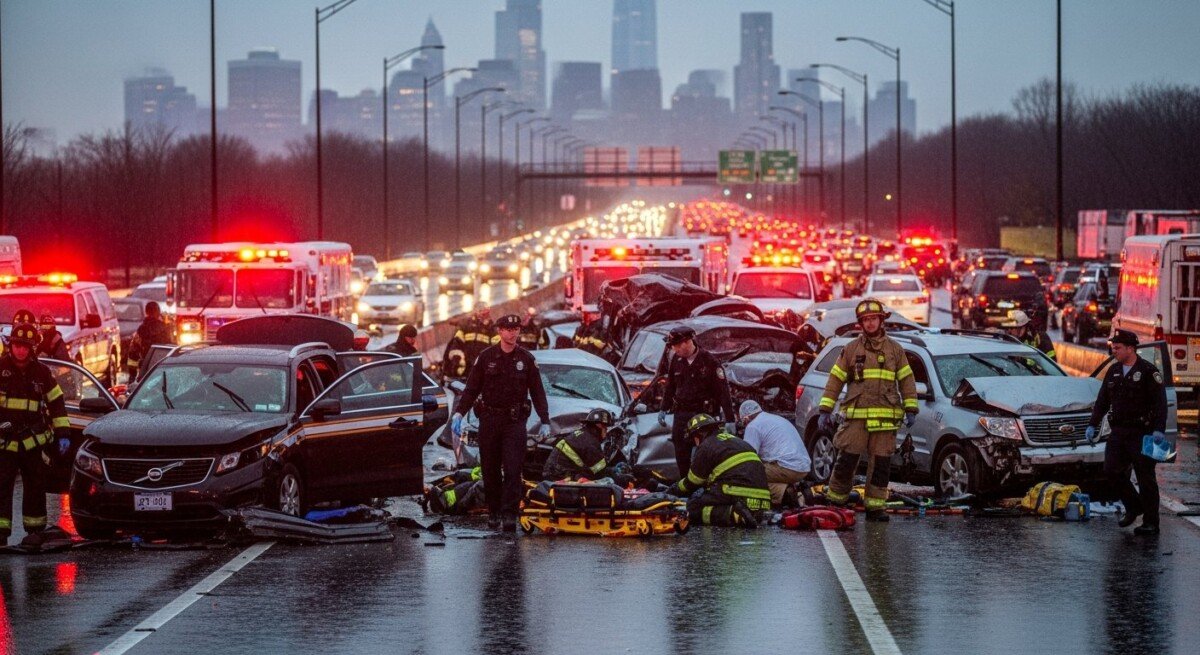
Suing for a Multi-Car Pileup Accident in New York
Understand your right to sue after a multi-car pileup in New York. For a free case evaluation, call our legal team at (833) 227-7919.

By Mateo Sinclair
A multi-car pileup on a New York highway is a chaotic and terrifying event. In the immediate aftermath, with damaged vehicles, injuries, and confusion about fault, victims are often left wondering about their legal rights. The short answer is yes, you can generally sue after a multi-car pileup in New York. However, the process is significantly more complex than a standard two-car accident. Successfully navigating a claim requires a clear understanding of New York’s unique no-fault insurance laws, the principles of comparative negligence, and the strategic investigation needed to identify all responsible parties.
New York’s Legal Framework for Multi-Vehicle Accidents
New York operates under a “no-fault” insurance system, formally known as Personal Injury Protection (PIP). This means that regardless of who caused the accident, your own auto insurance policy is the first source of compensation for medical expenses and lost earnings, up to the policy limits. This system is designed to reduce minor injury lawsuits. However, in serious multi-car collisions, injuries often exceed the “serious injury” threshold defined by New York law. When this happens, you step outside the no-fault system and gain the right to file a lawsuit against the negligent driver or drivers who caused the crash to recover for pain and suffering, and other economic losses beyond PIP coverage.
Determining fault in a chain-reaction crash is the central challenge. Unlike a rear-end collision, where liability is often clear, a pileup may involve multiple points of impact and varying degrees of negligence from several drivers. New York follows a “pure comparative negligence” rule. This means your compensation can be reduced by your own percentage of fault. If you are found 20% at fault for following too closely, and your total damages are $100,000, you can still recover $80,000 from the other at-fault parties. This rule makes it crucial to build a strong case that accurately apportions fault among all involved drivers.
Identifying Liable Parties in a Complex Pileup
Liability in a multi-car accident is rarely limited to the driver who initiated the chain reaction. A thorough investigation must consider all potential sources of negligence. The goal is to identify every party that may share responsibility to ensure you can seek full compensation, especially if one driver is underinsured.
Potential liable parties often include:
- The Initial At-Fault Driver: The driver whose action (e.g., sudden braking, distraction, speeding) first caused the collision.
- Subsequent Negligent Drivers: Drivers who may have been following too closely, were distracted, or failed to maintain control, causing them to hit vehicles already involved in the initial impact.
- Government Entities: If poor road design, missing signage, or failure to address known hazardous conditions contributed to the crash.
- Vehicle or Parts Manufacturers: If a mechanical failure, such as faulty brakes or defective tires, played a role in causing or worsening the accident.
- Commercial Trucking Companies: If a commercial vehicle is involved, the company may be liable under vicarious liability or for negligent hiring/maintenance.
Building this case demands immediate evidence collection. Photos of vehicle positions, skid marks, and road conditions, witness statements, and official police reports are invaluable. An experienced attorney will often work with accident reconstruction experts to analyze the physics of the crash and establish a credible sequence of events. This is essential for countering insurance companies that may try to pin disproportionate blame on you to minimize their payout.
The Critical Steps to Take After a Pileup
Your actions in the days and weeks following a multi-car pileup can profoundly impact your ability to sue successfully. First and foremost, seek immediate medical attention, even if you feel only minor pain. Adrenaline can mask serious injuries, and a medical record creates a direct link between the accident and your condition. Report the accident to the police and your own insurance company to initiate your no-fault (PIP) claim. Be cautious when speaking with other drivers’ insurance adjusters, who may call quickly to obtain a recorded statement that they can use against you later. It is advisable to politely decline to give a statement until you have consulted with legal counsel.
Given the complexity, consulting with a skilled personal injury lawyer is not just helpful, it is often imperative. A qualified attorney understands how to investigate multi-vehicle crashes, deal with multiple adversarial insurance companies, and navigate New York’s procedural hurdles. For insights on selecting qualified representation, our resource on how to identify the best personal injury lawyers in New York City outlines key criteria. They can also help you understand the full value of your claim, which includes not just current medical bills, but future care, lost earning capacity, and the significant non-economic impact of your injuries.
Navigating Claims and Litigation
The process of seeking compensation typically begins with filing claims against the insurance policies of all at-fault drivers. In a pileup, you may be dealing with several different insurers, each attempting to shift blame. Your attorney will handle these negotiations, presenting the evidence to establish liability and demand a fair settlement. If a settlement cannot be reached, filing a lawsuit becomes necessary. It is important to be aware of New York’s statute of limitations, which generally gives you three years from the date of the accident to file a personal injury lawsuit. Missing this deadline forfeits your right to sue permanently.
During litigation, the discovery process allows both sides to exchange evidence and take depositions. This phase is critical in multi-car cases to lock in testimony from other drivers, witnesses, and experts. Most cases settle before trial, but being prepared to go to court is essential for maximizing leverage. The presence of multiple defendants can lead to disputes among them about their respective shares of fault, which the court or jury will ultimately decide. A strong legal strategy anticipates these complexities. For broader context on legal advocacy in New York, you can explore New York personal injury law firm reviews and comparisons to understand firm capabilities.
Frequently Asked Questions
What if I was partially at fault for the pileup?
Under New York’s pure comparative negligence rule, you can still recover damages even if you are 99% at fault, though your recovery is reduced by your percentage of fault. However, being assigned significant fault can drastically reduce your compensation and make insurers more aggressive.
Can I sue if I only have minor injuries?
For minor injuries, you are typically limited to recovering economic losses (medical bills, lost wages) through your own no-fault (PIP) insurance. Suing for pain and suffering requires meeting the “serious injury” threshold defined by New York law, such as fracture, significant disfigurement, or permanent limitation of use of a body organ or member.
How long do I have to file a lawsuit?
The statute of limitations for personal injury from a car accident in New York is generally three years from the date of the accident. There are rare exceptions, but you should always operate under this three-year deadline.
What if the at-fault driver has no insurance or minimal coverage?
You would file a claim under your own policy’s Uninsured/Underinsured Motorist (UM/UIM) coverage. This is a critical reason to carry high UM/UIM limits. Your own insurer then steps into the shoes of the at-fault driver, and you may need to pursue arbitration or litigation against your own company to recover full damages.
How are damages calculated in such a complex case?
Damages include economic losses (past and future medical care, lost wages, property damage) and non-economic losses (pain and suffering, emotional distress, loss of enjoyment of life). In catastrophic injury cases, future care costs often constitute the largest part of the claim. An attorney will work with economists and life care planners to project these costs accurately.
Successfully pursuing a claim after a multi-car pileup demands a proactive and strategic approach. The interplay of no-fault rules, comparative fault, and multiple defendants creates a legal landscape where expert guidance is not a luxury but a necessity. Protecting your health and your legal rights starts with taking the right steps immediately after the crash. It is also worth noting that severe accidents can create financial distress beyond medical bills. If you are facing overwhelming debt due to accident-related costs, understanding all your legal options is important. For instance, how a New York bankruptcy lawyer can restart your finances explores one avenue for financial recovery, while some individuals may consider filing bankruptcy in New York without an attorney, though the complexities often warrant professional help. Your focus after a serious crash should be on physical and financial recovery, leveraging experienced legal support to navigate the challenging path toward fair compensation.