
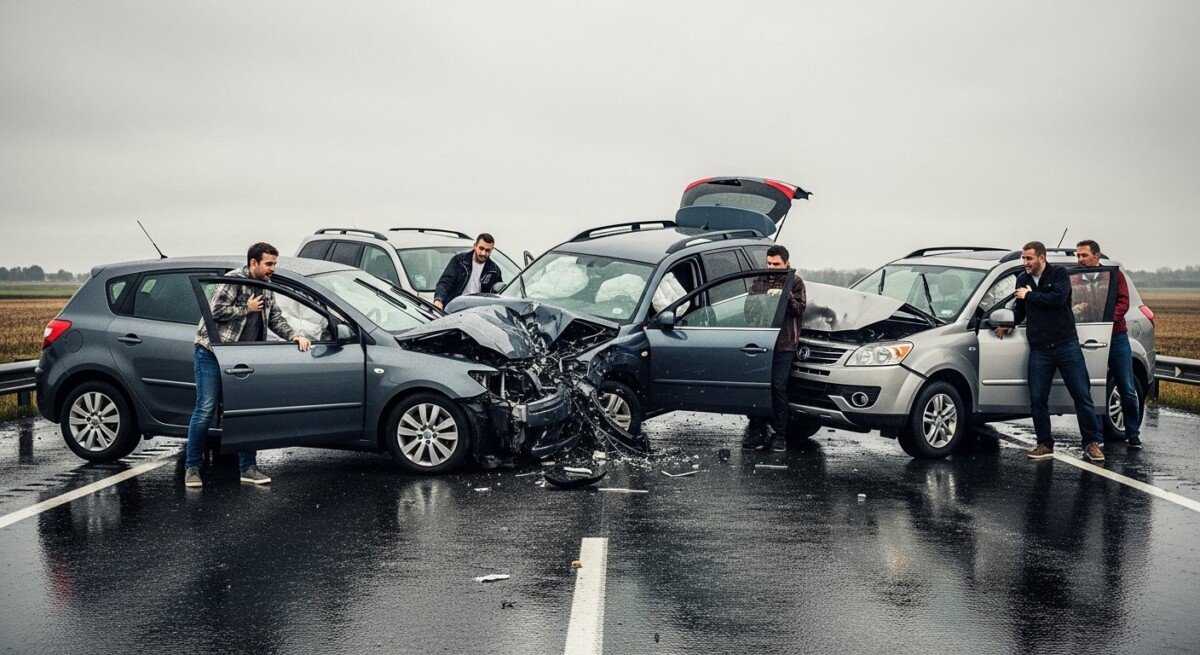
Suing After a California Chain Reaction Car Accident
Yes, you can sue after a chain reaction crash in California to recover damages. Call (833) 227-7919 for a free case evaluation with a specialist.

By Pierce Larkin
A chain reaction car crash on a California freeway is a chaotic and terrifying event. One moment traffic is flowing, the next, brakes slam, metal crunches, and multiple vehicles are entangled in a confusing pileup. In the aftermath, with injuries, damaged cars, and conflicting stories, victims are often left wondering who is truly at fault and, critically, who they can sue for their losses. The short answer is yes, you can sue after a chain reaction crash in California, but determining who to sue and proving liability requires navigating a complex web of California’s comparative fault laws and insurance regulations. Understanding your rights is the first step toward securing the compensation you need for medical bills, lost wages, and vehicle repairs.
Understanding Fault in a Multi-Vehicle Pileup
California is a “fault” or “tort” state for car accidents. This means the driver who causes a crash is financially responsible for the resulting damages. In a simple two-car collision, establishing fault can be straightforward. However, in a chain reaction crash involving three, four, or more vehicles, liability becomes a intricate puzzle. The key legal principle is negligence: did a driver fail to exercise reasonable care, and did that failure cause the collision? In a pileup, there may be multiple negligent parties. The driver who initiated the crash by rear-ending another car is typically primarily at fault for that initial impact. However, subsequent drivers may also share blame if they were following too closely, were distracted, or failed to maintain control to avoid the collision ahead, even if they were hit from behind first. California’s pure comparative negligence rule is crucial here. It allows an injured party to recover damages even if they are partially at fault, though their compensation is reduced by their percentage of fault.
Identifying All Liable Parties in a Chain Reaction Crash
Thoroughly investigating a chain reaction accident is essential to identify every potentially responsible party. Your claim may extend beyond the driver who hit your car directly. A comprehensive investigation will examine the actions of every driver in the sequence. For instance, if Driver A slams into Driver B, propelling Driver B into your car, both Driver A and Driver B could be liable for your injuries, depending on the circumstances. If Driver B had faulty brake lights, that could be a contributing factor. Furthermore, liability might not stop with individual drivers. If a commercial truck was involved, its employing company could be held vicariously liable. If a vehicle defect, like sudden unintended acceleration or brake failure, contributed to the crash, the manufacturer could be a defendant. In some cases, governmental entities may share blame due to dangerous road conditions, such as poorly designed merge lanes or missing signage. An experienced attorney will work with accident reconstruction experts to analyze physical evidence, vehicle damage patterns, traffic camera footage, and witness statements to build a complete picture of liability.
The Critical Role of Evidence in Your Claim
Success in a chain reaction crash lawsuit hinges on the strength of the evidence. Because insurance companies will aggressively defend their policyholders and often try to shift blame, you must build a compelling case. Essential evidence includes the official California Highway Patrol (CHP) or local police report, which provides an initial, authoritative account. However, these reports are not infallible and can be challenged or supplemented. Photographs and videos from the scene, showing vehicle positions, skid marks, road conditions, and injuries, are invaluable. Witness statements from independent observers can clarify the sequence of impacts. Your own medical records are the definitive proof of your injuries, from initial emergency room visits to long-term treatment plans. For specific injuries common in rear-end collisions, such as concussions or whiplash, detailed medical documentation is paramount. For example, understanding the process for suing for a concussion after a minor car accident in California highlights the need for expert medical testimony to link the injury to the crash. Similarly, while an MRI is strong evidence, you can still pursue a claim for soft-tissue injuries without one, as explained in our resource on suing for whiplash without MRI proof in California.
Navigating Insurance Claims and Bad Faith
Before a lawsuit is even filed, you will navigate the insurance claims process. In a multi-vehicle crash, you may have claims with multiple insurance companies: your own (for Personal Injury Protection or underinsured motorist coverage) and the insurers of the at-fault drivers. This process is often adversarial. Adjusters may try to minimize your injuries, argue you were partially at fault for following too closely, or delay settlement offers in hopes you will accept a lowball amount. It is vital to remember that insurance companies are not on your side; their goal is to settle for as little as possible. In some cases, an insurer may act in “bad faith” by unreasonably denying a claim, failing to conduct a proper investigation, or refusing to offer a fair settlement without justification. If you suspect bad faith, it becomes a separate legal issue that can significantly strengthen your leverage. While dealing with insurers, it is crucial not to provide recorded statements without legal counsel or sign any releases until you fully understand the long-term impact of your injuries.
What Damages Can You Recover in a Lawsuit?
A successful lawsuit after a chain reaction crash in California can recover both economic and non-economic damages. Economic damages are quantifiable financial losses. These include all medical expenses (ambulance, ER, surgery, physical therapy, future care), lost wages and loss of future earning capacity, property damage (vehicle repair or replacement), and out-of-pocket costs like rental cars or prescription medications. Non-economic damages compensate for the intangible, yet very real, consequences of the crash. This includes pain and suffering, emotional distress, loss of enjoyment of life, and inconvenience. In cases of severe, disfiguring injuries like broken bones after a California car accident, the compensation for pain and suffering can be substantial. In rare cases involving egregious misconduct (like drunk driving), the court may award punitive damages to punish the defendant and deter similar behavior.
Steps to Take Immediately After a Chain Reaction Accident
Your actions in the moments and days following the crash can profoundly impact your ability to sue successfully. First, ensure safety: if possible, move vehicles to the shoulder and turn on hazard lights. Call 911 immediately to report the accident and request medical assistance for anyone injured. Even if you feel fine, adrenaline can mask symptoms; accept medical evaluation at the scene. While waiting for authorities, if it is safe, gather evidence: take photos and videos from multiple angles, get contact information from all other drivers and witnesses, and note the location, time, and weather conditions. Do not discuss fault or apologize at the scene. Report the accident to your own insurance company promptly, but stick to the basic facts. Seek a full medical evaluation as soon as possible, even the next day, to document all injuries. Finally, consult with a personal injury attorney who specializes in multi-vehicle accidents before speaking to any other insurance adjusters or signing any documents.
Why You Need a Specialized Car Accident Attorney
The complexity of a chain reaction crash lawsuit makes legal representation not just advisable, but essential. An experienced attorney understands how to untangle the sequence of events and assign fault accurately under California law. They have the resources to hire accident reconstruction experts, biomechanical engineers, and medical specialists to build an irrefutable case. They handle all communication with aggressive insurance companies, protecting you from tactics designed to undermine your claim. A lawyer can accurately value your claim, accounting for future medical needs and long-term impacts, to ensure you do not settle for less than you deserve. They are also prepared to file a lawsuit and take your case to trial if a fair settlement cannot be reached. While legal fees are a concern, most personal injury attorneys work on a contingency fee basis, meaning you pay nothing upfront and they only receive a fee if they win compensation for you. This allows access to justice regardless of your financial situation. For those facing overwhelming debt from accident-related costs, understanding all legal options is critical, including knowing how to file bankruptcy in California without a lawyer in severe financial distress, though this is a separate legal path.
Frequently Asked Questions
What if I was the driver in the middle of the chain reaction? Your position does not automatically make you at fault. If you were struck from behind and then pushed into the car ahead, the driver who hit you is likely liable for the damage to both your car and the car you were pushed into. However, if you were following the car ahead too closely, you could share some fault for that second impact.
How long do I have to sue after a chain reaction crash in California? The statute of limitations for personal injury lawsuits in California is generally two years from the date of the accident. For property damage only, it is three years. Missing this deadline will almost certainly bar you from ever filing a lawsuit, making immediate legal consultation imperative.
What if the at-fault driver has minimal insurance? California’s minimum liability limits are notoriously low. If your damages exceed the at-fault driver’s policy limits, you may need to file claims against other negligent drivers or tap into your own underinsured motorist (UIM) coverage, which is designed for this exact scenario.
Can I sue if I was a passenger in one of the cars? Yes. As a passenger, you are almost certainly an innocent victim. You typically have the right to sue the drivers of any vehicles whose negligence contributed to the crash, potentially including the driver of the car you were riding in if they were partially at fault.
Will my case go to trial? Most personal injury cases, including complex multi-vehicle crashes, settle out of court through negotiation or mediation. However, having an attorney who is fully prepared and willing to go to trial is essential for maximizing your settlement leverage.
Navigating the aftermath of a chain reaction car accident is overwhelming, but you do not have to face insurance companies and legal complexities alone. By understanding your rights, preserving evidence, and seeking expert legal guidance, you can take decisive steps to protect your future and secure the full compensation California law allows for your injuries and losses. Taking action now can make a significant difference in your physical and financial recovery.